Summary: Renting a stump grinder is a practical and cost-effective way to remove tree stumps from a residential yard without hiring a tree service. A compact walk-behind stump grinder rental from Glenn’s Repair & Rental in Atascadero is sized for homeowners and fits through most yard gates. Before starting, call 811 to have utilities marked, clear rocks and debris from around the stump, and wear a full face shield, hearing protection, and heavy gloves — grinder teeth throw chips with significant force. Work the cutter wheel in slow side-to-side passes starting at the outer edge of the stump, grinding down 4 to 6 inches at a time until you’re at least 6 inches below grade. Most residential stumps under 18 inches in diameter can be ground completely in 30 to 90 minutes. Stumps near irrigation lines, buried utilities, fences, or with significant below-grade root mass are better handled by a professional.
A leftover stump in your yard is more than an eyesore — it’s a tripping hazard, an obstacle for mowing, and eventually a habitat for termites and wood-boring beetles if left to decay naturally. Hiring a tree service to grind it can cost $150 to $400 or more depending on stump diameter, but a stump grinder rental puts that same capability in your hands for a fraction of the price. The machine looks more intimidating than it actually is, and with the right preparation, most homeowners get through a residential stump job cleanly on their first rental.
Here’s a complete guide to the rental process, safety setup, and technique — everything you need to know before you pick up the machine from Glenn’s stump grinder rental in Atascadero.
Choosing the Right Stump Grinder for Your Job
Stump grinders come in several sizes, and picking the right one matters for both efficiency and access. Glenn’s carries compact walk-behind models suited for residential work, and larger self-propelled machines for bigger stumps or commercial applications.
For stumps under 18 to 20 inches in diameter in a typical residential yard, a compact walk-behind grinder is the correct choice. These machines weigh 400 to 700 pounds, maneuver well around landscaping, and narrow enough to fit through most standard yard gates without disassembly. They handle the overwhelming majority of residential stump removal jobs.
If you’re dealing with a stump over 24 inches across — the base of a large oak, walnut, or mature fruit tree — a mid-size or self-propelled grinder will work significantly faster and reduce operator fatigue. Ask the team at Glenn’s when you call ahead about stump diameter, species, and access constraints so the right machine is ready.
Before You Start: Safety and Site Prep
The preparation you do before turning the machine on determines how safely and efficiently the job goes. Stump grinder cutter wheels spin at high RPM and throw wood chips and occasionally rocks with enough force to cause serious injury or property damage. Proper prep eliminates most of the risk.
Call 811 before any stump removal near a fence line, property edge, or location where underground utilities might run. Grinding a stump directly over an irrigation lateral, gas line, or electrical conduit causes costly damage and potential hazard. 811 marks utilities at no charge within a few business days.
Once utilities are confirmed clear, clear the area around the stump of rocks, gravel, and any metal objects — old stakes, buried wire, chain link remnants — within about three feet of the work zone. A single rock caught by a cutter tooth can damage the machine and send debris well beyond a reasonable clearance radius. Move any patio furniture, vehicles, or items you don’t want chipped away from the work area.
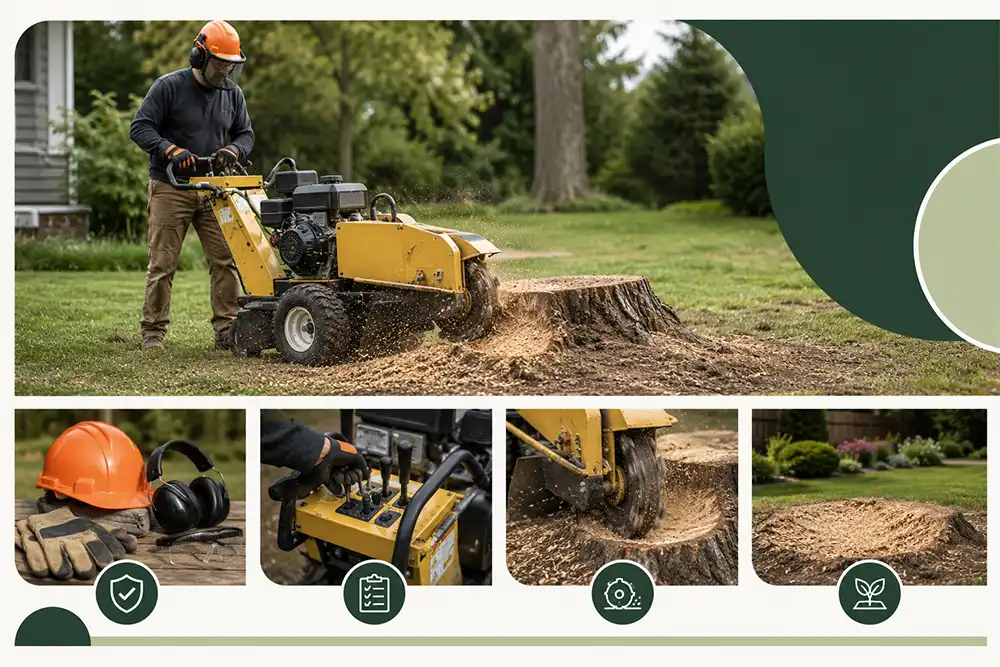
Personal protective equipment for stump grinding is non-negotiable: a full face shield (not just safety glasses), hearing protection rated for high-noise equipment, heavy leather gloves, and close-toed boots. Long pants are strongly recommended. Observers — including children, pets, and bystanders — should stand at least 50 feet back and preferably behind a solid barrier during active grinding.
How to Operate a Walk-Behind Stump Grinder
Once the machine is running, the technique is straightforward but requires deliberate control. The cutter wheel should never be plunged directly down into the center of the stump at full depth. Instead, work from the outer edge inward in slow, controlled side-to-side passes, removing 2 to 4 inches of material at a time before repositioning.
Start at the highest point of the stump — usually the outer rim — and sweep the cutter wheel slowly from one side to the other while lowering it incrementally. The machine’s hydraulics control the wheel’s up-and-down movement; the operator guides the side-to-side swing. Grind each section to your target depth before moving to the next, working your way toward the center. Most residential jobs require getting at least 6 inches below the surrounding soil grade so sod and landscaping can grow back without stump interference.
After the main stump mass is ground, address the large surface roots that radiate outward. You don’t need to grind roots to their full extent — following a root three or four feet from the stump is usually sufficient. What remains will decay underground over the following year or two.
| Stump Diameter | Estimated Grinding Time | Recommended Machine Size |
|---|---|---|
| Under 10 inches | 15–30 minutes | Compact walk-behind |
| 10–18 inches | 30–90 minutes | Compact walk-behind |
| 18–24 inches | 1–2 hours | Mid-size grinder |
| Over 24 inches | 2+ hours | Larger self-propelled model |
After Grinding: Cleanup and Backfill
Grinding produces a substantial pile of wood chips and sawdust directly in and around the stump hole. This material is useful — it can be raked into low spots around the yard, used as mulch in planting beds, or composted. It does not make good topsoil backfill by itself because it will continue to decompose and settle, creating low spots over time.
For a lawn area where you want to reseed, fill the hole with clean topsoil after removing the majority of the chip material. Tamp it down lightly, add a thin top layer, seed, and water. With the right timing, new grass fills in within three to four weeks in warm Central Coast weather.
If you have multiple stumps to grind and want to move chips efficiently between sites, pairing the stump grinder rental with a dump trailer rental from Glenn’s makes cleanup significantly faster.
When to Call a Professional Instead
Most residential stumps are straightforward DIY candidates, but a few situations genuinely warrant professional help. Stumps within 18 inches of a foundation, retaining wall, or buried irrigation main are risky to grind without a professional assessment of what’s below. Very large stumps from hardwood species — old oaks, walnuts, and eucalyptus — can have root systems that extend well beyond what a single rental day accommodates. And if the stump sits at the base of a slope or in a location with limited stable footing for the machine, the safety calculus shifts toward hiring out.
For anything straightforward — a pine stump, a fruit tree, an ornamental that needs clearing for a patio project — renting is almost always the practical and cost-effective answer. Call Glenn’s at 805-466-2218 to check availability and confirm which machine size fits your job. Glenn’s serves Atascadero, Paso Robles, Templeton, San Luis Obispo, and the surrounding Central Coast area.
Frequently Asked Questions
Is renting a stump grinder difficult for a homeowner?
For most residential stumps under 20 inches in diameter, a walk-behind stump grinder is manageable for a homeowner who follows proper safety procedures and takes time to understand the controls before starting. Glenn’s staff walks every renter through operation before the machine leaves the yard. The learning curve is short — most renters feel comfortable within the first 15 minutes of operation — but patience with slow, controlled passes matters more than speed.
How long does it take to grind a stump?
A stump under 10 inches in diameter typically takes 15 to 30 minutes to grind to 6 inches below grade. Stumps in the 10 to 18 inch range take 30 to 90 minutes depending on wood hardness and root spread. Planning for a half-day rental gives most homeowners comfortable time to grind one to three stumps of average size plus handle cleanup.
How deep does a stump grinder go?
Most compact walk-behind stump grinders can grind to 8 to 12 inches below grade, which is sufficient for lawn restoration. If you’re planning to pour concrete or install a hardscape structure directly over the stump site, grinding deeper or removing roots more extensively may be necessary — discuss this with Glenn’s when booking.
Can a stump grinder cut through roots?
Yes. The cutter wheel is designed to cut through wood at all angles, including lateral surface roots. Most operators grind three to four feet along major surface roots to reduce future sprouting and to ensure the surface flattens properly for grass restoration. Deep tap roots are not typically addressed in standard grinding — they decay underground on their own over one to three years.
How hard is it to use a walk-behind stump grinder?
The controls on a walk-behind stump grinder are straightforward once explained: a hydraulic lever controls the wheel’s height, and the machine is positioned by hand between passes. The physical demand comes from maneuvering the machine between grinding positions and managing the debris pile. Most homeowners in reasonable physical condition handle it without difficulty. The critical discipline is working slowly and not forcing the wheel into material faster than it can clear — patience protects both the machine and the operator.
Related Posts