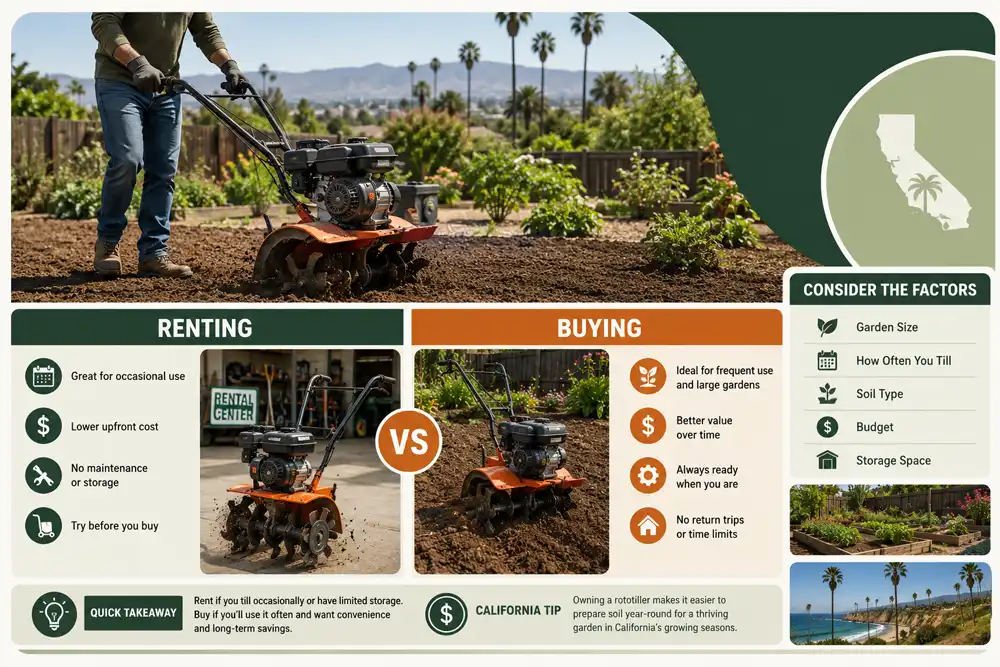
Summary: For most California homeowners who till once or twice per year, renting a rototiller is almost always more cost-effective than buying one. A mid-size rear-tine rototiller rental costs $60–$100 per day at Glenn’s Repair & Rental in Atascadero. Purchasing a comparable machine runs $700–$1,800 before storage, maintenance, and carburetor service costs. The math shifts toward buying only if you’re tilling frequently — four or more times per year — across a large area like a hobby farm or commercial growing operation. For seasonal garden prep, raised bed construction, and lawn renovation, renting delivers a better machine for less total cost, with no storage footprint or annual tune-up expenses.
Every spring, homeowners across Atascadero, Paso Robles, and the surrounding Central Coast face the same question before prepping their garden beds: rent a rototiller for the day, or invest in one of their own? The honest answer depends on how often you actually use it — and for the majority of California homeowners, the numbers favor renting by a significant margin.
Here’s a complete look at what each option costs, what maintaining a tiller actually involves in California’s climate, and how to know which side of the line your situation falls on.
The True Cost of Buying a Rototiller
The sticker price on a rototiller is only the beginning of the ownership cost. A front-tine tiller adequate for light garden work runs $350 to $600 for a name-brand model. A rear-tine tiller — the appropriate machine for breaking new ground, working heavy clay soil, or tilling larger areas — costs $700 to $1,800 depending on engine size and tine configuration. Commercial-grade units run higher still.
Beyond purchase price, ownership carries ongoing costs that are easy to underestimate. An annual tune-up including oil change, spark plug, and air filter service runs $60 to $120 at a small engine shop. Carburetor issues — extremely common in California when ethanol-blended fuel sits in a machine for months between seasonal uses — add $80 to $200 in repair costs. Tines wear and eventually need replacement at $100 to $200 per set. Storage requires protected space since exposed equipment in California’s UV-intense environment degrades belts, seals, and plastics faster than in more temperate climates.
Over a five-year ownership period, a $900 rear-tine tiller with normal maintenance and one significant repair realistically costs $1,400 to $1,700 in total. That’s 14 to 17 rental days — spread across five years — to reach breakeven.
What Renting Actually Costs
A mid-size rear-tine rototiller rental from Glenn’s Repair & Rental in Atascadero runs approximately $60 to $100 per day depending on the machine. Half-day rates are available for smaller projects. Most residential garden prep — tilling a 500 to 1,500 square foot vegetable garden or lawn area — takes two to four hours with a properly sized machine, making a half-day rental the right fit for many jobs.
Crucially, the rental machine is maintained, freshly serviced, and available in the right size for your specific project. A homeowner who tills twice per year spends $120 to $200 annually on rentals — a fraction of purchase plus maintenance cost — with no storage requirement, no carburetor headaches, and access to a commercial-grade machine rather than a consumer model.
| Factor | Renting | Buying |
|---|---|---|
| Upfront cost | $60–$100/day | $700–$1,800 |
| Annual maintenance | $0 | $60–$200+ |
| Storage required | No | Yes |
| Machine quality | Commercial-grade | Consumer-grade (at budget price) |
| Carburetor/fuel issues | Not your problem | Your responsibility |
| 5-year total cost (2x/year use) | $600–$1,000 | $1,400–$2,200 |
California-Specific Considerations
California’s climate creates some equipment ownership dynamics that don’t apply in other regions. The long dry season means small engine equipment often sits unused for five to eight months between fall and spring use — exactly the conditions that cause ethanol-blended fuel to varnish carburetors and gum up fuel systems. This is the single most common cause of rototiller service issues in the Central Coast area, and it’s an ownership problem, not a rental problem.
California’s sun intensity is also harder on rubber belts, plastic housings, and fuel lines than less UV-intensive climates. Equipment stored even in partial outdoor exposure degrades faster. If your storage is limited to a shed or carport without full UV protection, depreciation and repair frequency accelerate noticeably.
The other California-specific factor is soil variability. Atascadero and Paso Robles soils range from sandy loam in some areas to genuine adobe clay in others — particularly in low-lying areas and north-facing slopes. Clay soil in summer is brutally hard on front-tine tillers and requires a more powerful rear-tine machine to work effectively. Rather than buying a machine sized for your hardest conditions, renting the right machine for the specific season and soil state makes consistent sense.
When Buying a Rototiller Makes Sense
The ownership math does eventually favor buying for high-frequency users. If you’re tilling three or more times per year across a significant area — a large vegetable garden, multiple raised bed systems, a hobby orchard with cover crops, or a small market farm operation — the per-use rental cost accumulates faster and ownership provides meaningful convenience. At four or more tilling sessions per year, you reach breakeven in two to three years depending on machine cost.
If you already have excellent covered storage, a working familiarity with small engine maintenance, and the discipline to run stabilizer through the fuel system before long storage periods, the ongoing ownership challenges are manageable. For this type of user, buying a quality rear-tine tiller makes sense as a long-term investment.
For the majority of Central Coast homeowners with one vegetable garden and seasonal lawn work, renting is simply the better financial decision — and the better practical one, since you walk away with access to a machine that’s been professionally maintained rather than one that may or may not start reliably after sitting since last October.
Right-Sizing the Machine for Your Project
When you rent, you also get to choose the right machine for the job at hand rather than being locked into whatever you own. A mini-tiller is sufficient for loosening established bed soil between growing seasons. A mid-size rear-tine tiller is the right tool for breaking new ground or working a 1,000-square-foot garden area. A large rear-tine tiller with counterrotating tines is what makes sense for dense clay, compacted soil, or areas that haven’t been tilled in years.
Glenn’s carries multiple tiller sizes for exactly this reason. If you’re unsure which machine fits your soil type and project area, call 805-466-2218 before booking and the team can recommend the right fit. You can also read the companion guide on how to use a rototiller to prep your garden for technique tips once you’ve got the right machine reserved.
Frequently Asked Questions
Is it cheaper to rent or buy a rototiller?
For homeowners who till once or twice per year, renting is consistently cheaper when you account for purchase price, annual maintenance, repairs, and storage costs. The five-year total cost of ownership for a mid-range rear-tine tiller is typically $1,400 to $2,200, while two rental days per year for five years costs $600 to $1,000. Buying becomes cost-effective at four or more tilling sessions per year.
What size rototiller do I need for a home garden?
For an established vegetable garden up to 1,000 square feet with reasonably workable soil, a mid-size front-tine or rear-tine tiller handles the job in a couple of hours. For breaking new ground, working clay soil, or covering more than 1,000 square feet, a rear-tine model with more engine displacement is the right choice. Glenn’s team can match a machine to your soil type and square footage when you call to book.
How long does it take to rototill a garden?
A 500-square-foot vegetable garden takes 30 to 60 minutes to till with a mid-size rear-tine tiller in decent soil. A 1,500-square-foot area takes 1.5 to 3 hours depending on soil condition, obstacles, and whether you make one or two passes. Breaking ground for the first time, or working very hard summer clay, adds significantly to the time. A half-day rental comfortably covers most residential garden projects.
Can I use a rototiller to level my yard?
A rototiller loosens soil but doesn’t level it — it follows the existing contour and aerates the surface without moving material from high spots to low spots. For actual leveling, a mini skid steer or box blade grading tool is the right equipment. A tiller can be useful as a follow-up step after rough grading, to break up and loosen the surface before seeding or top dressing. For projects that involve both grading and soil prep, consider pairing a mini skid steer and a tiller rental on the same day.
What’s the difference between front-tine and rear-tine tillers?
Front-tine tillers have tines located in front of the engine that pull the machine forward as they rotate, making them lighter and easier to maneuver but less effective in hard or compacted soil. Rear-tine tillers place the tines behind the engine, drive the wheels independently, and dig more aggressively — they’re the appropriate choice for breaking new ground, working clay, or covering large areas. For most California garden prep jobs in existing beds, a front-tine model is sufficient. For anything involving hard soil or new ground, rent a rear-tine.
Related Posts