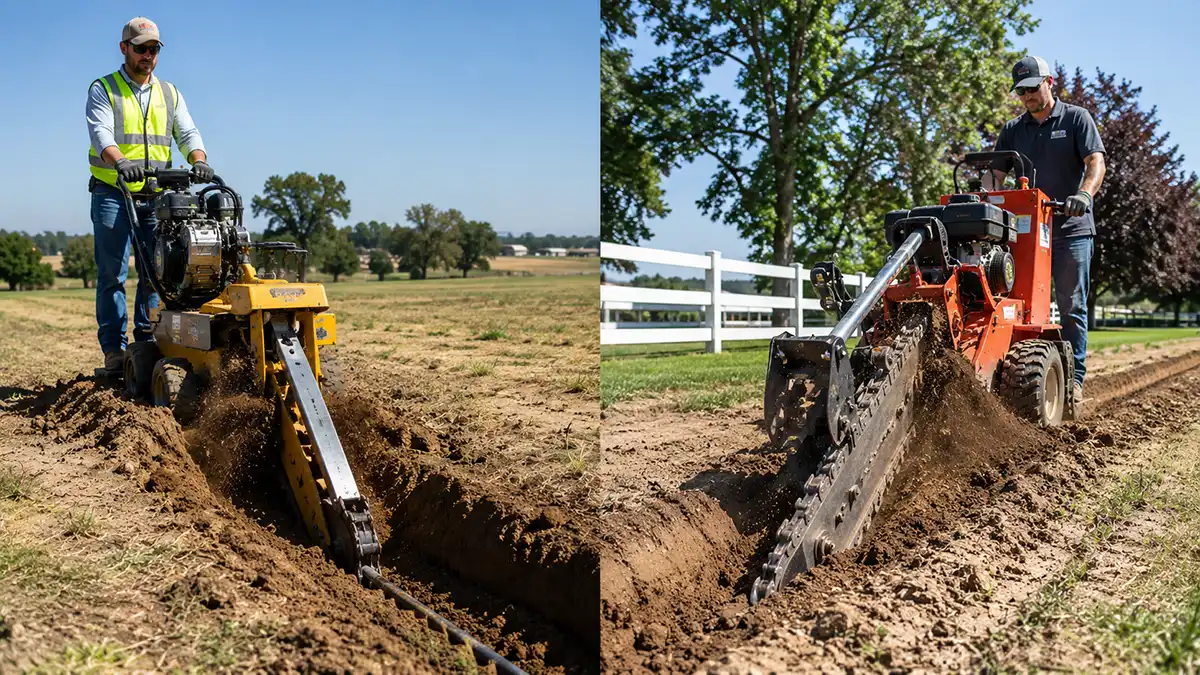
Summary: A GeoRipper is a walk-behind attachment that slices a narrow trench using a spinning blade, making it ideal for irrigation lines, low-voltage wire, and fiber installation in soft-to-medium soil. A traditional trenching machine uses a chain-and-tooth system to excavate wider, deeper channels and handles harder soil, tree roots, and rocky ground more effectively. For most residential landscape and irrigation projects in the Central Coast region, a GeoRipper rental is faster to set up, causes less surface damage, and costs less per day than a full-size trencher. If you’re cutting deeper than 12 inches, working in compacted clay, or crossing a root-heavy zone, a walk-behind chain trencher is the better choice.
If you’re laying irrigation pipe, running a drip line, or burying low-voltage cable across your property, you’ll face an immediate equipment decision before the first foot of dirt moves: rent a GeoRipper or a traditional trenching machine? Both tools open a channel in the ground, but they work differently, cost differently, and suit very different conditions. Getting this choice right saves you a half-day of work and potentially significant rental fees.
Glenn’s Repair & Rental in Atascadero stocks both options and helps Central Coast homeowners, landscapers, and contractors make this call every season. Here’s exactly what separates these two machines and how to pick the right one for your specific project.
How Each Machine Works
The GeoRipper uses a high-speed rotating blade, similar in concept to a circular saw, to slice through soil and create a narrow trench, typically between 1 and 4 inches wide and up to 12 inches deep. Because it cuts rather than excavates, it displaces very little soil, leaves a tight channel, and can be pulled across a lawn without tearing up the surface on either side. The result is a slot trench: clean enough to drop in a half-inch irrigation line and close back up with minimal restoration.
A chain trencher operates like a continuous loop of teeth rotating around a bar, similar to a chainsaw blade running vertically through the earth. This design lets it break through harder soil, cut through small roots, and dig wider, deeper channels, typically 4 to 6 inches wide and anywhere from 12 to 36 inches deep depending on the machine size. The spoil piles alongside the trench and needs to be managed separately. It’s a more aggressive tool that opens up more material but requires more cleanup afterward.
Speed and Productivity Comparison
On favorable soil, sandy loam or amended garden soil, a GeoRipper rental can move at a surprisingly fast walking pace, covering 150 to 300 feet per hour depending on conditions. It’s genuinely one of the faster tools for simple shallow trenching when soil cooperates. A walk-behind chain trencher in the same conditions will move at a similar rate but with more cleanup involved.
Where the speed math shifts is in difficult conditions. Hard, dry clay — common in Atascadero and Paso Robles during summer — slows a GeoRipper considerably and can cause blade wear. A chain trencher powers through with far less resistance because its teeth are designed to break material rather than slice it. If your yard hasn’t been watered recently or the soil profile contains significant clay content, plan accordingly.
| Factor | GeoRipper | Chain Trencher |
|---|---|---|
| Trench Width | 1–4 inches | 4–6 inches |
| Typical Depth | Up to 12 inches | 12–36 inches |
| Soil Displacement | Minimal | Significant |
| Root Handling | Small roots only | Handles larger roots |
| Lawn Damage | Very low | Moderate |
| Best For | Irrigation, wire, fiber | Deep utilities, hard soil |
| Typical Rental Cost | Lower daily rate | Higher daily rate |
The Right Choice for Irrigation Projects
For standard residential irrigation installation — running half-inch or three-quarter-inch poly pipe from a valve box out to heads — the GeoRipper is almost always the right call. Most irrigation systems run between 6 and 10 inches deep, which sits comfortably within the GeoRipper’s range. The narrow slot trench means your turf recovers in days rather than weeks, and you spend almost no time backfilling since the soil essentially falls back into the cut.
The one irrigation scenario where a chain trencher earns its place is when you’re installing a mainline that needs to clear a freeze line depth, cross a dense root zone near established trees, or navigate the rocky decomposed granite common in parts of the Templeton and Santa Margarita foothills. In those cases, renting a mini trencher is the more practical approach.
Fiber and Low-Voltage Wire Installation
Running conduit for landscape lighting, speaker wire, or fiber optic cable is where the GeoRipper really stands out. These installs typically need only 6 to 8 inches of depth and care more about surface preservation than trench volume. The GeoRipper’s slot cut is exactly the right profile: narrow enough to grip the conduit in place, shallow enough to complete quickly, and gentle enough on surrounding grass and groundcover that you can often work right up to planted beds without significant disturbance.
When to Choose a Trenching Machine Instead
Several scenarios clearly favor a chain trencher over the GeoRipper. If you’re burying a water main that needs to run below 12 inches, digging a French drain that requires a wider channel for gravel backfill, working in caliche or hard clay that hasn’t been irrigated recently, or crossing an area with significant tree root presence, a conventional trencher gives you the power and capacity to do the job properly without forcing equipment past its design limits.
Contractors installing conduit runs for electrical or irrigation systems across longer distances — 300 feet or more — often prefer the chain trencher’s consistent depth control and its ability to maintain a straight, clean wall regardless of soil conditions.
Rental Tips for Either Machine
Regardless of which machine you choose, a few preparation steps make the rental day go much smoother. Water the work area thoroughly the night before — even an hour of irrigation can dramatically improve how either machine performs in local summer soil. Call 811 before any digging to have utilities marked at no cost. And plan your path before you start: once either machine opens a trench, it’s a commitment to close it cleanly.
If you’re unsure which tool fits your specific project, call Glenn’s at 805-466-2218. The team can look at your soil type, project depth, and line length and recommend the right machine for the day. Both the GeoRipper/mini trencher and larger chain trencher rentals are available for daily and half-day rental out of Atascadero, serving Paso Robles, Templeton, San Luis Obispo, and the surrounding Central Coast area.
Frequently Asked Questions
Is a GeoRipper faster than a trencher?
In soft to medium soil, a GeoRipper can move at roughly the same pace as a walk-behind chain trencher — around 150 to 300 feet per hour. In harder, drier, or rocky soil, the chain trencher typically outperforms the GeoRipper because its tooth system is built for breaking hard material rather than slicing through it.
How deep can a GeoRipper dig?
Most GeoRipper models dig to a maximum depth of 12 inches. This is sufficient for irrigation lines, low-voltage electrical conduit, drip tubing, and fiber installations. For anything requiring greater depth — water mains, French drains, electrical service runs — a chain trencher or mini excavator is the appropriate tool.
Can a GeoRipper cut through roots?
A GeoRipper handles small, fibrous roots reasonably well but is not designed to cut through substantial lateral roots from trees or large shrubs. Attempting to force a GeoRipper through major roots risks blade damage and stalls the machine. A chain trencher handles moderate roots more effectively, though large roots near established trees may still require hand tools or an arborist’s input.
When should I rent a trencher instead of a GeoRipper?
Choose a chain trencher when your project requires depth beyond 12 inches, when working in compacted clay or caliche, when crossing root-heavy areas, when you need a wider trench for gravel or backfill material, or when the total trench run is long enough that a more powerful machine’s speed advantage justifies the higher rental cost.
How much trench can a GeoRipper dig per hour?
Under good conditions — moist loamy soil with no significant obstructions — a GeoRipper can produce roughly 150 to 300 linear feet of trench per hour. Sandy or recently watered soil speeds this up; dry clay or rocky terrain slows it considerably. For planning purposes, budget conservatively at 100 to 150 feet per hour if you’re unsure about your soil conditions.
Related Posts