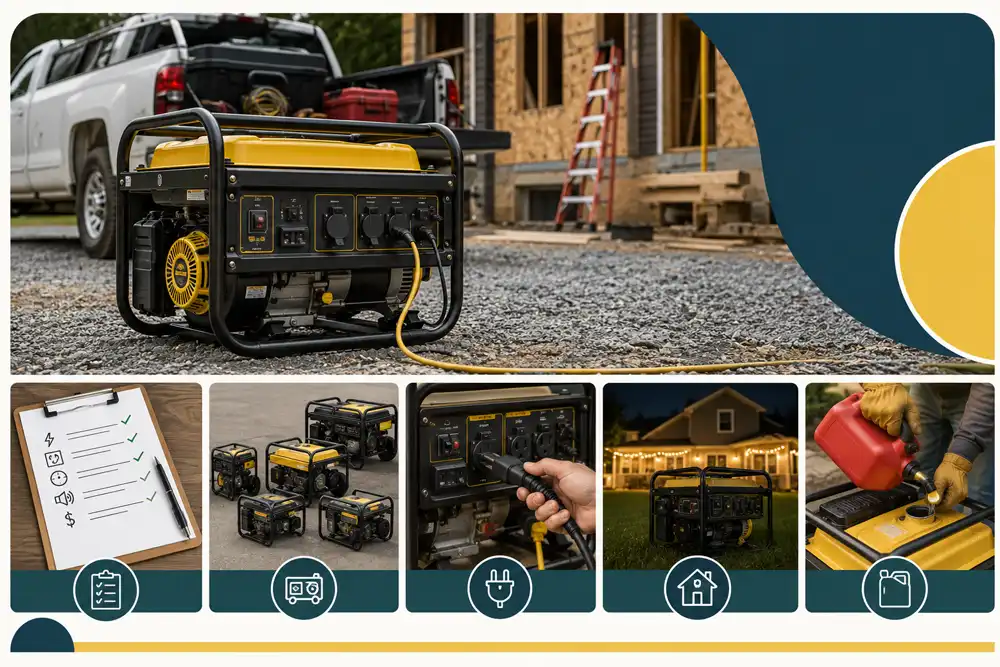
Summary: The right generator rental size depends on what you need to power simultaneously. A 2,000-watt inverter generator handles basic needs like lights, a phone charger, a fan, and a small appliance. A 3,000-watt model adds a window AC unit or a small compressor. A 6,500-watt generator covers a job site with multiple tools running at once, or a home’s essential circuits during a power outage. Always add up the starting wattage — not just the running wattage — of your largest motor-driven appliance, then add the running watts of everything else. Glenn’s Repair & Rental in Atascadero rents Honda inverter generators (EU2200i, EU3000iS) and conventional generators up to 6,500 watts and 10,000 watts for Central Coast job sites, events, and outages.
Booking the wrong generator size is one of the most common and frustrating rental mistakes — either you’re constantly tripping breakers because the machine is underpowered, or you’re paying for capacity you never needed. Getting it right is a simple math exercise, and this guide walks through exactly how to do it before you call to reserve.
Glenn’s Repair & Rental in Atascadero carries Honda inverter generators and conventional generators across multiple wattage ranges, covering everything from a quiet weekend campsite to a full job site with saws, compressors, and lighting running simultaneously.
Understanding Starting Watts vs. Running Watts
Every generator has two wattage ratings: running watts (the sustained output it can deliver continuously) and starting watts (the brief surge it can handle when a motor-driven device kicks on). Motor-driven appliances — air compressors, circular saws, refrigerators, AC units, pumps — all draw two to three times their running wattage for the fraction of a second at startup. If your generator can’t cover that surge, it trips or shuts down.
When sizing a generator, always start with the highest-startup-demand item you’ll be running and base your minimum generator size on its starting wattage alone. Then add the running wattage of everything else you’ll have on simultaneously. That total is your minimum generator requirement.
| Device | Running Watts | Starting Watts |
|---|---|---|
| Refrigerator | 150–400W | 800–1,200W |
| Window AC (10,000 BTU) | 900–1,200W | 2,200–2,800W |
| Air compressor (small) | 1,000–1,500W | 3,000–4,500W |
| Circular saw (7-1/4″) | 1,400–1,800W | 2,400–4,000W |
| LED work lights (4 units) | 200–400W | 200–400W (no surge) |
| Phone/device chargers | 50–150W | 50–150W (no surge) |
| Sump pump (1/2 HP) | 800–1,050W | 1,300–2,150W |
Which Generator Size Matches Your Use Case
2,000–2,200 Watts: Camping, Tailgating, and Light Use
A Honda EU2200i in this range is the quiet, fuel-efficient choice for situations where you need a small amount of power with minimal noise. It handles device charging, small fans, a few LED lights, a small TV, and one small appliance running at a time. It’s not suited for motor-driven tools or air conditioning. This is the generator for a campsite, an outdoor event booth, or a food vendor setup with a small cooler and lighting.
3,000 Watts: RV Hookups and Residential Backup Essentials
The Honda EU3000iS sits in an excellent middle range for homeowners. It runs a window AC unit (barely), a refrigerator, lights, and device charging simultaneously — covering the critical comforts during a PG&E outage without the noise and fuel consumption of a large conventional generator. It’s also well-suited for an RV where you want to run the roof unit and a few accessories.
This size is also appropriate for a light framing job where you’re running one tool at a time — a circular saw, a drill, or a jigsaw — with lights and charging happening in the background.
6,500 Watts: Serious Job Sites and Whole-Home Essentials
At 6,500 running watts, you’re covering a fully equipped job site or powering multiple circuits in a home during an extended outage. This size runs a table saw, air compressor, and work lighting simultaneously. For home use, it powers the refrigerator, several lights, a window AC, the microwave, and device charging all at once — nearly everything except a central HVAC system or electric range.
Contractors doing concrete work, roofing, or framing at a remote site without utility power commonly use this size. It also serves well for large outdoor events where multiple vendors or sound systems share power.
10,000 Watts: Heavy Commercial and Industrial Use
A 10,000-watt generator handles large compressors, multiple power tools running simultaneously, commercial food service equipment, or significant job site electrical loads. This is the appropriate size for large construction projects, major outdoor events with stage lighting and sound, or facilities that need to run heating, cooling, and production equipment during an outage.
Inverter vs. Conventional Generator: Which to Rent
Inverter generators — like the Honda EU series — produce cleaner, more stable power that’s safe for sensitive electronics including laptops, phones, and variable-speed tools. They’re quieter, more fuel-efficient at partial load, and significantly lighter. For any use case involving electronics or noise-sensitive environments, an inverter model is the right choice.
Conventional generators produce power at a fixed frequency regardless of load. They’re louder, heavier, and less fuel-efficient but typically less expensive to rent and available at higher wattage ceilings. For straightforward job site applications where you’re running power tools and lighting — not electronics — a conventional generator does the job efficiently.
Runtime and Fuel Planning
Generator fuel consumption depends heavily on load. A 6,500-watt conventional generator running at 50% load typically burns 0.6 to 0.8 gallons of gasoline per hour. At full load, that climbs to 1.0 to 1.2 gallons per hour. For a full eight-hour day at moderate load, plan for 5 to 7 gallons of fuel.
Honda inverter generators are significantly more efficient: the EU3000iS at half load consumes roughly 0.3 gallons per hour, giving you 20 hours on a full tank. If your project runs across multiple days or requires extended overnight power, fuel cost is a real part of the rental economics — and the inverter models become considerably cheaper to operate.
Booking Your Generator Rental
Call Glenn’s at 805-466-2218 or check the generator rental catalog for current availability. If you’re unsure which size fits your specific load, the team can walk through your equipment list and make a recommendation before you book. Glenn’s serves Atascadero, Paso Robles, Templeton, San Luis Obispo, Morro Bay, and surrounding Central Coast communities.
Frequently Asked Questions
What size generator do I need for a job site?
For a typical residential construction job site running a circular saw, air compressor, and work lights simultaneously, a 6,500-watt generator covers the load comfortably. If you’re also running a table saw or a second compressor at the same time, plan for 8,000 to 10,000 watts. The key calculation is the starting wattage of your largest motor-driven tool plus the running watts of everything else active at the same time.
Can I run a house on a rental generator?
A 6,500-watt generator covers most residential essentials during an outage: refrigerator, lights, window AC, microwave, and device charging. It won’t power a central HVAC system, electric water heater, or electric range. A 10,000-watt generator handles more simultaneously but still can’t replace your full panel load. For clean, quiet power for electronics during an outage, the Honda EU3000iS is an excellent option for covering the critical loads without running the largest circuits.
Is a Honda inverter generator worth the higher rental cost?
For applications involving laptops, phones, sensitive audio equipment, variable-speed tools, or quiet environments, yes — the clean power output and significantly lower noise level of Honda inverter generators justify the premium. For straightforward job sites running basic power tools, a conventional generator is often the better value. Glenn’s carries both types to match the right machine to your actual needs.
How much fuel does a rental generator use?
A conventional 6,500-watt generator at 50% load burns approximately 0.6 to 0.8 gallons of gasoline per hour. A Honda EU3000iS at half load uses about 0.3 gallons per hour, lasting roughly 20 hours on a full tank. For a full eight-hour day with a conventional generator, budget 5 to 7 gallons of fuel depending on your actual load.
Can I rent a generator for a power outage?
Yes, and Glenn’s keeps generator inventory available for exactly this reason. During extended outage events, call early — 805-466-2218 — as demand for generators spikes quickly after major storms or PG&E PSPS shutoffs. If you’re in a fire-risk area or frequently experience outage events, asking Glenn’s about reservation options in advance is worthwhile.
Related Posts