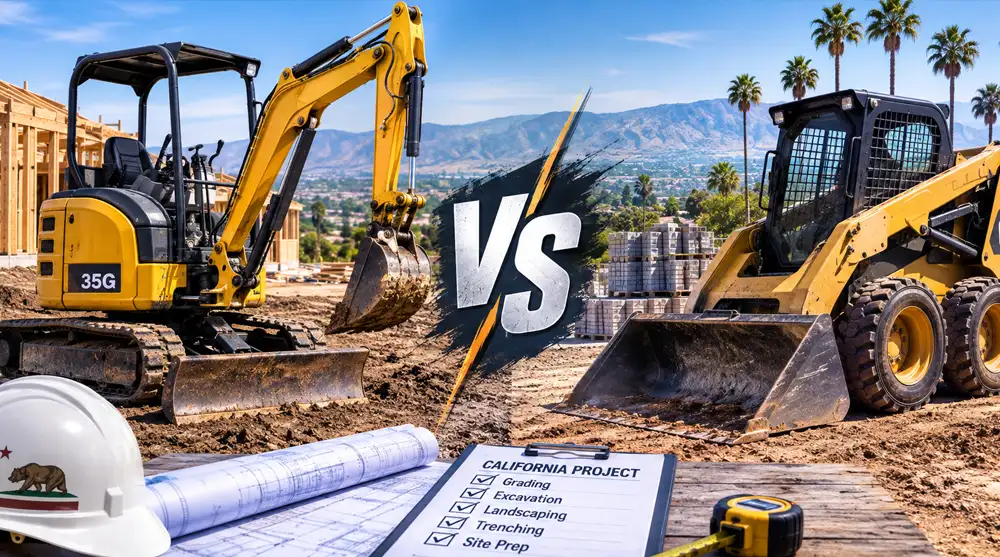
Summary: Mini excavators and skid steers get lumped together as general purpose construction equipment, but they solve different problems on a job site. A mini excavator digs, using a boom and arm to reach below grade for trenches, footings, and utility lines. A skid steer moves and grades material at or above grade, and its wide range of attachments makes it the faster choice for site cleanup, landscaping, and material handling. This guide breaks down what each machine does best, how their costs compare, and which one fits common Central Coast projects like drainage trenching, backyard regrading, and debris removal, so the choice is clear before calling to reserve one.
Glenn’s fields the same question from a lot of first time renters standing in front of the earthmoving equipment: excavator or skid steer? Both machines show up on residential and small contractor job sites across the Central Coast, and both can look interchangeable to someone who has not run either one before. They are built for different jobs, and picking the right one up front saves a full day of rental time and, on some projects, a machine that simply cannot do what the job requires.
What a Mini Excavator Does Best
A mini excavator’s boom, arm, and bucket are built to dig down. That makes it the right machine for anything that requires reaching below the existing grade, including trenches for drainage lines or irrigation, footings for a shed or retaining wall, utility line installation, and pond or drainage basin work. The rotating house lets the operator dig and swing to dump material to the side without repositioning the whole machine, which matters on tighter residential lots where maneuvering room is limited.
Mini excavators also handle demolition work well, particularly breaking up smaller concrete slabs or removing tree stumps and root balls, since the digging force comes from the hydraulic arm rather than the machine’s weight alone. For a project that is fundamentally about removing material from below ground level, a mini excavator is almost always the right call.
What a Skid Steer Does Best
A skid steer works at or above grade, using its lift arms and a bucket, or one of several swappable attachments, to push, carry, lift, and grade material. It moves faster across a site than an excavator and covers ground more efficiently, which makes it the better choice for spreading gravel or mulch, rough grading a yard before sod or landscaping goes in, clearing brush, loading a dump trailer, and general material handling around a property.
The attachment range is where a skid steer earns its versatility. Beyond the standard bucket, forks, a grapple, or a brush cutter attachment can turn the same base machine into a tool for a completely different task, without needing a second piece of equipment on site. For projects centered on moving and shaping material rather than digging deep, a skid steer typically finishes the job faster than a mini excavator would.
Cost and Footprint Differences
Mini excavators and skid steers rent in a similar general price range at Glenn’s, so cost alone rarely decides the choice between them. Footprint is often a bigger factor on residential jobs. A mini excavator’s compact frame and rotating house make it easier to work in tight side yards or narrow gate access, while a skid steer’s wider stance and faster ground speed make more sense on open lots where covering distance efficiently matters more than maneuvering into a tight corner.
Both machines require a trailer with sufficient towing capacity for transport, and Glenn’s team can advise on trailer requirements when a rental is booked. Call 805-466-2218 for current availability and daily rates on either machine.
Matching the Machine to the Project
A drainage trench, a new irrigation line, or a footing dig calls for a mini excavator every time, since none of those jobs can be done properly at grade. A backyard regrade before new sod, a debris cleanup after tree removal, or spreading a load of gravel across a driveway calls for a skid steer, since the job is about moving material efficiently rather than digging below the surface. Larger projects sometimes need both: a mini excavator to dig utility trenches followed by a skid steer to backfill and grade once the lines are in.
Homeowners specifically comparing trenching options for underground utility work may also want Glenn’s GeoRipper vs. trenching machine comparison, which covers a narrower, purpose built trenching tool alongside these two broader options.
Pairing With a Dump Trailer for Cleanup
Both machines generate material that needs to leave the property, whether it is excavated soil, demolition debris, or cleared brush. Loading a dump trailer directly with either the excavator or the skid steer is significantly faster than hand loading, and the hydraulic dump makes unloading at a transfer station a one person job. Glenn’s dump trailer rental guide covers sizing the trailer correctly for the volume and weight of material a given project produces.
Mini Excavator and Skid Steer Rentals Serving the Central Coast
Glenn’s Repair & Rental keeps both mini excavators and skid steers in the rental fleet at 5025 El Camino Real in Atascadero, serving Paso Robles, Templeton, San Luis Obispo, Morro Bay, and Pismo Beach. The team walks first time operators through controls and safe operation before equipment leaves the lot, and can help match the right machine, or combination of machines, to a specific project. Browse current earthmoving inventory in the earthmoving equipment category or call 805-466-2218 to check availability.
Frequently Asked Questions
What is the difference between a mini excavator and a skid steer?
A mini excavator digs vertically using a boom, arm, and bucket, and is built for precise digging below grade, such as trenches, footings, and utility work. A skid steer works at or above grade, using its lift arms and a range of attachments to grade, push material, and lift, making it better suited to site cleanup, material handling, and general landscaping.
Can a skid steer dig as deep as a mini excavator?
No. A skid steer’s bucket digs at or near ground level and cannot reach the depths a mini excavator’s boom and arm can achieve. For anything requiring digging several feet below grade, such as footings or deep trenching, a mini excavator is the right choice.
Do I need a special license to rent a mini excavator or skid steer?
No special license is required to rent either machine in California for private property use. Glenn’s team walks first time operators through the controls and safe operation before the equipment leaves the lot. Call 805-466-2218 with questions about a specific project.
Which is better for landscaping a backyard?
For most backyard landscaping work, such as grading, moving soil or mulch, and clearing debris, a skid steer is more efficient because of its speed and attachment versatility. If the project also involves digging trenches for drainage or irrigation lines, a mini excavator handles that portion of the work better.
Can I rent a dump trailer along with the excavator or skid steer?
Yes. Pairing either machine with a dump trailer is one of the most efficient combinations for excavation or landscaping cleanup, since the machine loads material directly into the trailer for hauling. Details on trailer sizing are in Glenn’s dump trailer rental guide.
Related Posts